Baking Sheet Storage: Vertical Dividers That End the Pile
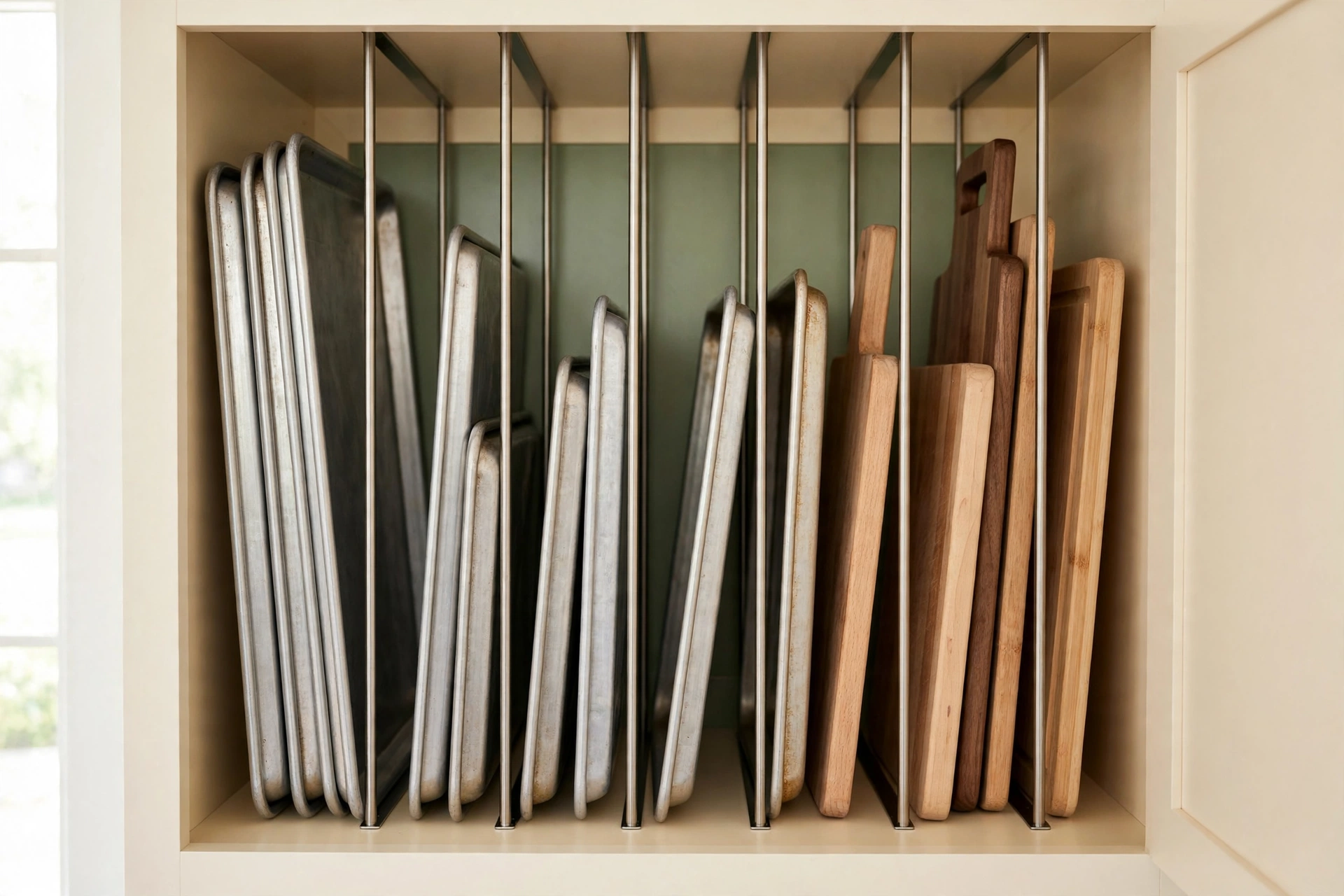
Open the cabinet, pull the middle sheet pan, and the whole stack slides forward like a slow-motion avalanche. Baking sheets, muffin tins, and cutting boards are flat, heavy, and slippery, which makes stacking them one of the worst storage choices in a small kitchen. The fix is to stop stacking entirely: store them upright, like files in a filing cabinet, using simple vertical dividers. A tension rod or a pair of wire file holders turns a messy pile into a row of slots where every pan is visible and one-handed to grab. Nothing here requires drilling, and everything comes back out cleanly at move-out.
Why Stacking Fails (and What Upright Changes)
A stacked pile of sheet pans fails in three predictable ways. First, the middle pan is always the one you want, so you lift the top three, the stack shifts, and something slides out of the cabinet. Second, heavy piles scratch nonstick coatings and warp thinner pans over time, because every grab scrapes metal on metal. Third, cutting boards lean against the pile and slip sideways, especially thinner ones, until they jam the cabinet door. Storing everything upright solves all three at once: each piece gets its own slot, you pull exactly the one you need, and nothing rests its full weight on anything else.
Method 1: The Tension-Rod Divider
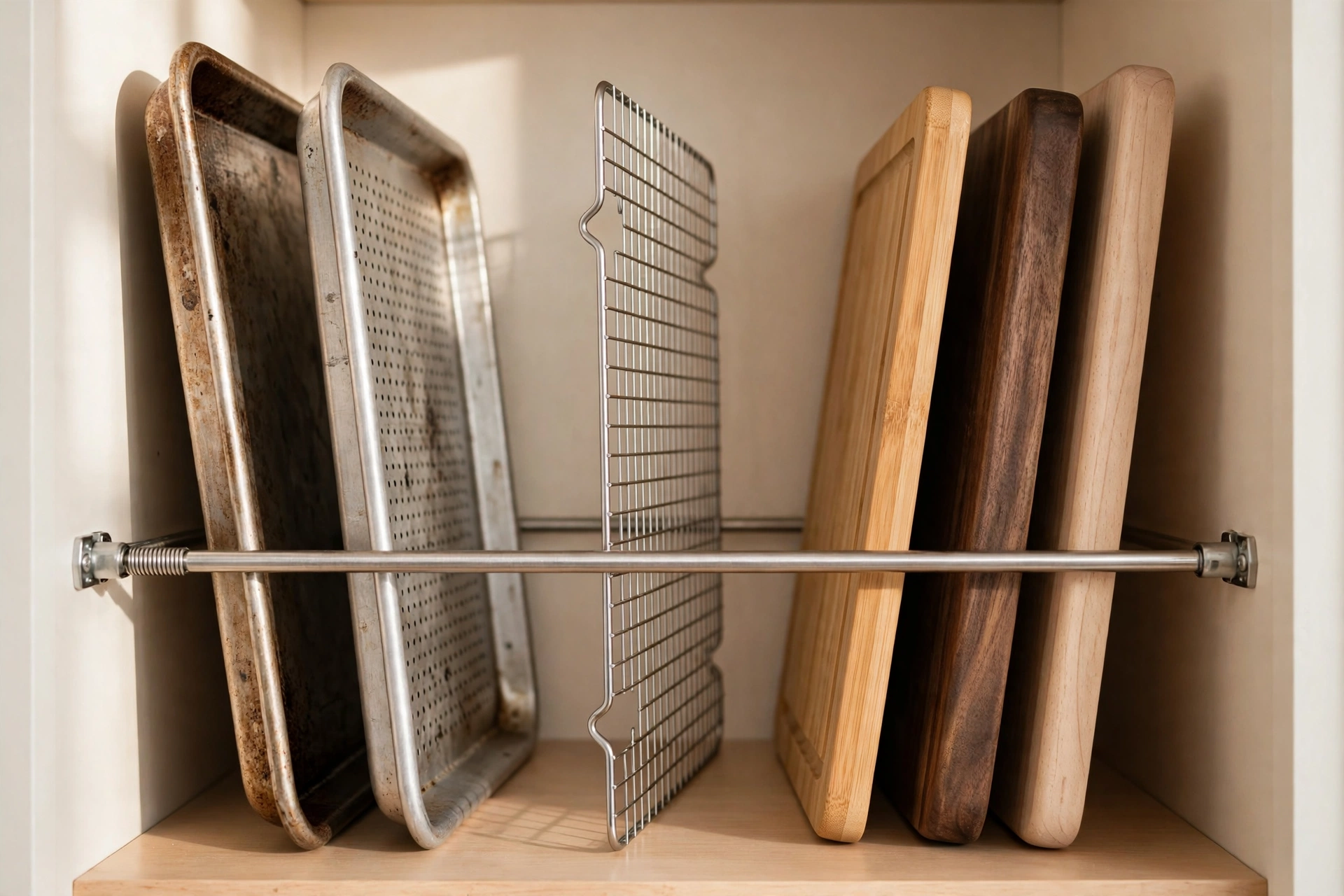
A tension rod wedged across the cabinet creates a front stop that sheet pans and boards lean against, forming instant upright slots. It is the same no-drill principle behind our renter-friendly kitchen upgrades without drilling holes: pressure holds it in place, and at move-out it twists loose in seconds with no marks. A standard shower-style or cabinet tension rod in the 9 to 15 inch range costs about $8 to 15 and covers most cabinet widths when extended.
Place the rod horizontally across the cabinet opening, roughly at the height of the items’ midpoint. Half sheet pans are 18 by 13 inches, so with the pan standing on its 13 inch edge it reaches 18 inches tall; set the rod around 10 to 12 inches up from the shelf. Stand the pans upright behind the rod, leaning back slightly against the cabinet wall, and the rod’s spring pressure plus the slight lean keeps each piece from falling forward. Give each sheet pan a slot about 2.5 to 3 inches wide, cutting boards 1 to 1.5 inches, and muffin tins or thin racks about 1 inch. If a rod feels loose on greasy cabinet walls, wipe the contact points with rubbing alcohol and let them dry before twisting it tight.
Method 2: Dollar-Store File Holders
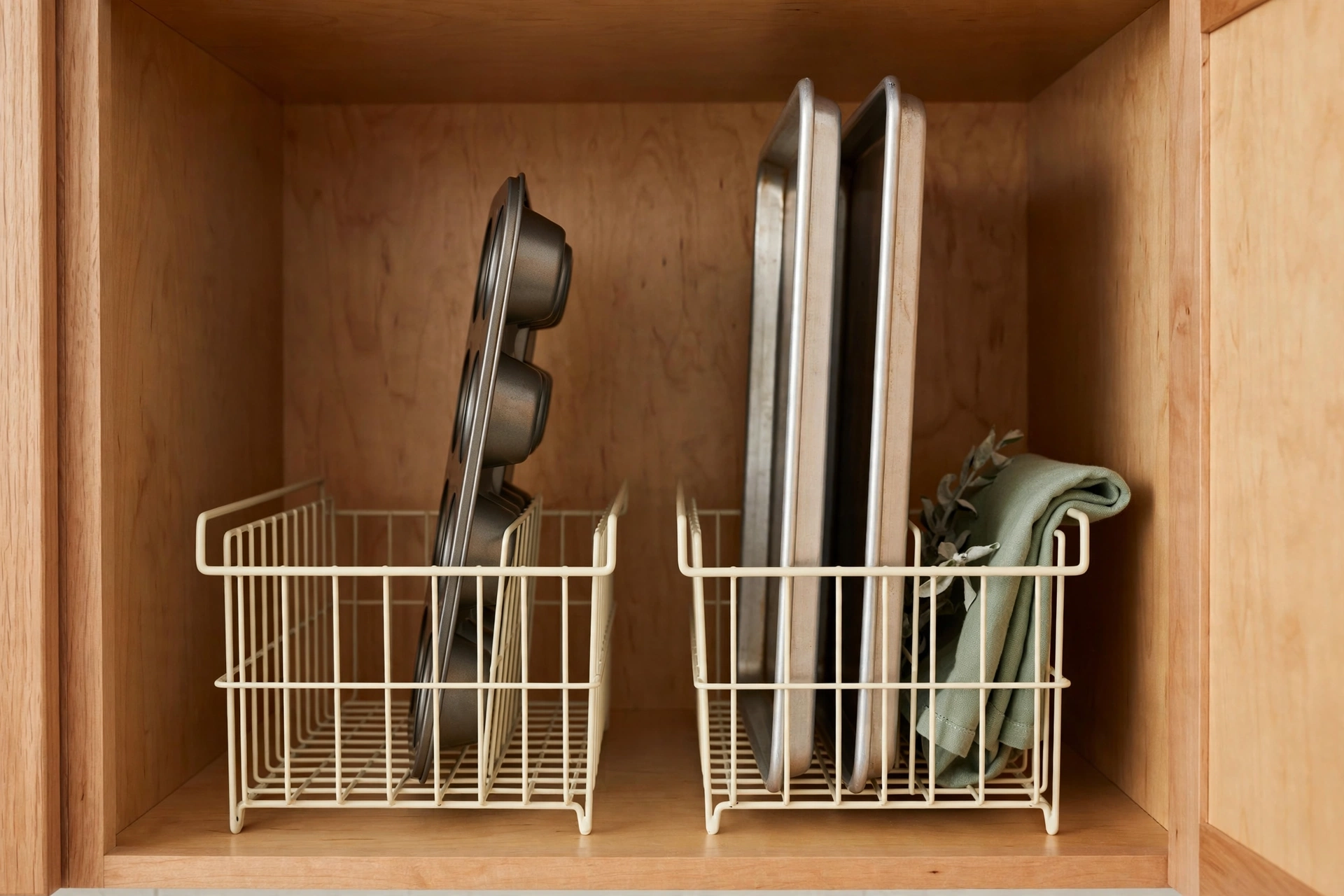
Wire file holders from a dollar store or discount bin are the cheapest upright dividers available, often $1 to 3 each. Stand one or two inside the cabinet and slide muffin tins, sheet pans, and cooling racks between the wire frames, like magazines. They work especially well in 12 inch deep wall cabinets where a full tension-rod setup is awkward, and the wire frames are rigid enough to hold a thin tray without flexing. Choose metal over plastic near the stove side of the cabinet, and skip any coated wire that is already chipping, since flaking coating can land in food.
Measure Before You Buy
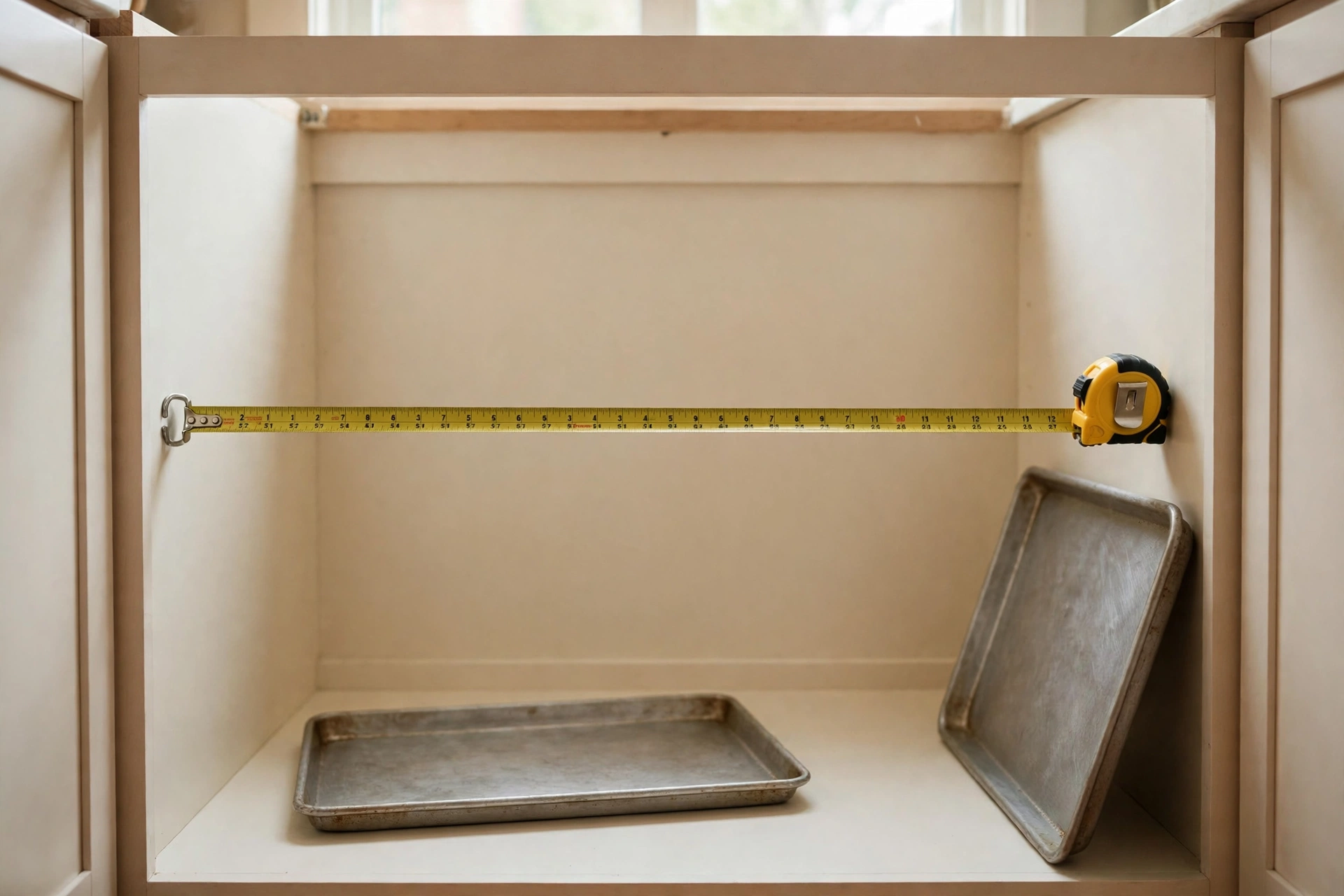
The most common mistake is buying dividers that do not fit the cabinet. Standard base cabinets are about 24 inches deep with interior height around 24 to 27 inches above the bottom shelf, while wall cabinets are 12 inches deep. A half sheet pan standing on its 13 inch edge needs 18 inches of vertical clearance plus a finger’s width to lift it out, so confirm your interior height before committing to the full-upright position. In a shorter wall cabinet, store the pan on its 18 inch edge instead (13 inches tall), or lay just the tallest items flat and stand the rest upright.
For tension rods, measure the cabinet width where the rod will sit, not at the front lip, since cabinet interiors can taper slightly. Buy a rod whose range brackets your measurement: a rod rated 9 to 15 inches holds best in a 12 inch opening, where it stays near the middle of its range rather than fully extended. For file holders, measure the cabinet depth and confirm the holder’s footprint leaves at least an inch of clearance behind it so the cabinet door closes without pushing items forward. For more budget storage wins like these, our small pantry organization ideas on a tight budget follows the same dollar-store logic.
What Fits Where
Not every flat item wants the same slot. Quarter sheet pans and muffin tins are short, so group them in one holder or one section of the rod where they cannot fall through a wide gap. Full and half sheet pans are the heaviest items; give them the widest slots and place them at the ends of the row where the cabinet walls add extra support. Cooling racks are thin and light, so tuck each rack against a heavier pan that keeps it from tipping. Cutting boards vary: thin plastic boards slide between any two items, while heavy wooden boards deserve their own 1.5 inch slot at the end of the row where they act like a bookend.
Deep Cabinets and Corner Cabinets
In a deep 24 inch base cabinet, one file holder at the front leaves a dead zone behind it. Run two holders front to back: the front one for daily pans, the rear one for the roasting pan and pizza stone you use monthly. In a blind corner cabinet, the same file-holder pair fits inside the pullout or the reachable shelf, since the corner’s awkward depth is exactly what upright storage handles well. If you use a tension rod in a deep cabinet, place a second rod midway back so items in the rear section have their own front stop instead of leaning across the whole depth.
Keep the Slots From Toppling
Upright storage only works if the slots stay upright. Three habits keep it that way. First, never fill the last slot completely; one empty or half slot gives you room to slide a pan back in without forcing it and tipping the row. Second, clean grease off the tension rod’s rubber pads every few months, because a slick pad loses grip and the rod drops at the worst moment. Third, store the heaviest sheet pans at the ends of the row and the lightest racks and boards in the middle, so the row’s center of gravity stays stable when you pull one item out.
Renter-Friendly Check
Both methods are fully renter-friendly. A tension rod leaves no holes and no adhesive residue; it twists out of the cabinet in seconds. File holders are freestanding organizers with nothing to attach, peel, or patch. As with every upgrade in this guide, skim your lease for any specific rules about cabinet modifications before you start, and note that these are methods designed to come down cleanly, not promises about any individual landlord or deposit outcome.
Your Next Step
Pull out your three most-used sheet pans and one cutting board, measure your cabinet’s width and interior height, and pick your method: tension rod for a deep base cabinet, file holders for a shallow wall cabinet. Set it up in under ten minutes and the next time you need the middle pan, you will slide it out of its slot with one hand while nothing moves. If this cabinet finally feels calm, our complete guide to small kitchen organization is the natural next read, with zone-by-zone plans for the rest of the kitchen.