18 Under-Bed Storage Ideas for Small Apartments

A standard bed takes up about 30 square feet of floor. The space under it is often the largest unused storage area in a small apartment, big enough to hold all of your seasonal clothes, your luggage, and most of your spare bedding at once. The only reason most of that space sits empty is fit: the wrong container for the clearance, or no plan for reaching things once they slide under.
These 18 ideas fix both problems. They cover how to measure and create clearance, which containers suit which bed frames, what to store under there (and what not to), and how to keep the whole thing dust-free and usable instead of a dark place where things disappear.
First, Make It Fit
Idea 1: Measure your clearance at the lowest point. Kneel down with a tape measure and check the gap between the floor and the lowest part of the bed frame. Check the middle too, not just the corners: center support bars often sit lower than the frame edges. Every container choice below depends on this one number, so write it down. If the gap is under 4 inches, nothing rigid will slide under it, and you need Idea 2 first.
Idea 2: Add height with bed risers. Bed risers are cups or blocks that sit under each leg or corner and lift the whole frame at once. A standard set adds a few inches of clearance in a few minutes, with no tools and no need to move the mattress off the frame. Less than twenty dollars buys a set that turns a too-low bed into a usable storage zone. Note the honest limit: risers add inches, not a foot, so a platform bed sitting nearly flush with the floor may need a different approach.

Idea 3: Match the container to your clearance band. Use your measurement as a shopping filter. Under 4 inches of clearance: soft fabric zip bags that fold and slide (Idea 7). Around 6 to 7 inches: low-profile rolling bins. Around 8 inches or more: taller bins with lids, stackable where the frame allows. Buy containers shorter than the gap by at least half an inch so they glide in without scraping.
Idea 4: Keep one long side fully accessible. Under-bed storage only works if you can reach it. In a studio or small bedroom, place the bed so the longer side faces the room, not the wall. This is the same zone thinking from our studio layout guide: the bed zone needs a working edge, not just a sleeping surface. If the bed sits between two walls, use the foot end instead.
Choose the Right Containers
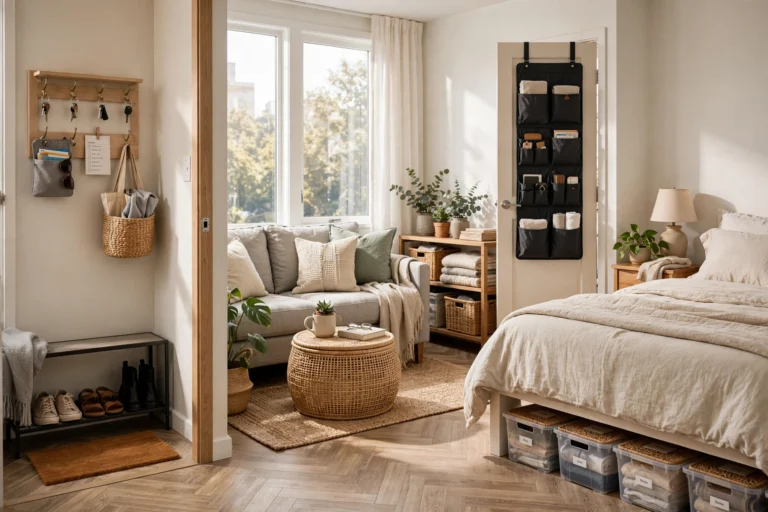
Idea 5: Low-profile clear bins, the workhorse. Clear plastic bins with lids are the most versatile under-bed container. You can see what is inside without pulling each one out, the lid keeps dust off, and most are sized around 6 to 7 inches tall to fit standard frames. Choose bins with a handle or a cutout on the front edge so you can grip and pull them. For a full bed, three or four bins side by side usually fill the space.
Idea 6: Rolling drawers with casters, for things you grab often. A rolling under-bed drawer works like a dresser drawer you never had: pull it out on wheels, take what you need, push it back. These are ideal for items you reach for weekly rather than seasonally, like spare towels or workout clothes. On carpet, look for larger wheels that roll rather than drag. Locking casters keep the drawer parked where you put it.
Idea 7: Fabric zip bags for very low frames. If your bed sits only a few inches off the floor and risers are not an option (rented frames, warranty concerns), soft zippered bags fold flat and slide into clearance a rigid bin cannot. They also fold away to nothing when empty, which bins never do. The trade-off: less protection for delicate items, and no rigid lid to stack against.
Idea 8: Vacuum bags for bulky seasonal items. A winter comforter or a set of puffy coats takes up an absurd amount of space. Vacuum bags shrink them by more than half, and the flat sealed packages slide neatly into a bin or lie directly on the floor under the frame. Keep a small hand pump with the bags so recompressing after a trip takes two minutes. Reserve vacuum bags for soft goods; they can crease or compress structured items like boots.

Idea 9: Use your luggage as storage. The suitcase you use twice a year is already a large, lidded, wheeled container. Fill it with off-season clothes or spare bedding between trips. It costs nothing, uses space you were already giving up, and stays packed and ready when travel day comes. Just remember it is there, so you do not buy a separate bin for the same items.
What to Store Under There
Idea 10: Seasonal clothing, swapped twice a year. This is the number one use for under-bed storage. Pack the clothes you will not wear for the next few months: winter coats and sweaters in summer, shorts and sandals in winter. Fold by category, and keep one smaller bag on top for the shoulder-season pieces you might grab early.
Idea 11: Extra bedding and spare linens. Guest sheets, the backup comforter, and spare pillowcases live perfectly under the bed. They are bulky, used occasionally, and belong near the bed anyway. One full bin usually holds a complete spare bedding set, so bed-change day means pulling out one container instead of digging through a closet shelf.
Idea 12: Shoes, in pairs and visible. A low rolling shoe organizer or a pair of shallow bins can hold a surprising number of pairs where the closet floor is already full. Store shoes in matched pairs, ideally in the slots or rows of a dedicated organizer, so you never pull out one shoe and hunt for its partner. Keep daily shoes by the door; under the bed is for the second string.
Idea 13: A gift wrap and holiday decor station. Wrapping paper rolls, gift bags, ribbon, and a small box of holiday decorations fit in one long bin or a fabric bag with side pockets. This frees a whole closet shelf, and wrapping becomes a one-bin task instead of a scavenger hunt. Cut paper rolls to the bin's length if needed so they slide in without bending.
Idea 14: Toy bins that roll out. In a kid's room, a rolling bin of toys slides out for playtime and back under for cleanup, which makes tidying a two-minute job instead of a standoff. A clear front lets kids see their options without dumping everything out. For shared kids' rooms, one bin per child ends the ownership disputes.
Idea 15: Books, games, and hobby supplies. Board games, the books you are currently reading, knitting or craft supplies: anything flat and occasionally used fits beautifully in shallow bins. These are the overflow items that clutter nightstands and shelves. Our 45 renter-friendly storage ideas has more ways to absorb hobby overflow around a small apartment.
Idea 16: Keepsakes and documents in lidded boxes. Photo albums, important paperwork, and memory boxes do not need daily access, and under the bed keeps them out of sight but easy to reach. Use lidded, dust-resistant containers, and keep paperwork in a waterproof folder inside the box as insurance against spills from above.
Idea 17: Bulky extras you rarely touch. The air mattress for guests, camping gear, the extra set of curtains, the carry-on you only use in summer. These awkward items waste prime closet space. Under the bed, they are out of the way but still inside the apartment, which beats a storage unit for things you use a few times a year.

Keep It Dust-Free and Usable
Idea 18: Label everything and rotate twice a year. The difference between storage and a black hole is a label. Use clear bins, label holders, or a strip of painter's tape on each container: “winter clothes,” “guest bedding,” “gift wrap.” Then, twice a year, pull everything out, wipe the bins, vacuum the floor underneath, and swap the seasons. The full rotation takes about an hour and resets the system. Pair this routine with the zone method from our complete small apartment guide so the bed zone stays working as one system.
A few rules keep the system healthy. Always use lids or zip closures: open containers under a bed collect dust and, in ground-floor apartments, can attract pests. Do not store food, candles that can melt, or anything moisture-sensitive directly on the floor. And leave a small gap between containers so air circulates and you can grip each one to pull it out.
FAQ: Under-Bed Storage Questions
How much clearance do I need under the bed?
Measure first. Under 4 inches fits only soft zip bags. Around 6 to 7 inches fits most low-profile rolling bins. Around 8 inches or more opens up lidded bins with real capacity. Bed risers can add a few inches to a frame that is close but not quite there.
Will bed risers damage my bed frame?
Risers made for bed frames cup the leg and spread the load. They are a standard, renter-safe accessory. The main cautions: buy the right size for your leg shape, make sure all four corners sit level so the frame does not wobble, and check that the raised bed still feels stable before loading the bins.
How do I keep under-bed storage from getting dusty?
Closed containers are the answer: lids, zip closures, or vacuum-sealed bags. Wipe or vacuum under the bed twice a year during your seasonal rotation. Fabric bags with zippered tops work fine; open-top bins do not.
What should I never store under the bed?
Food and anything attractive to pests, candles or items that melt with heat, electronics sensitive to dust, and anything you need to grab in a hurry, like a fire extinguisher or a first aid kit. Also skip anything the bed's weight could crush, like framed photos without protection.
Is it okay to store clothes under the bed long term?
Yes, in closed containers with clean, dry clothes. Make sure garments are fully dry before packing to prevent mildew, use lids or zip bags rather than open bins, and refresh the contents during your twice-a-year rotation. Vacuum bags work well for bulky seasonal items you will not touch for months.
Your Next Step
Grab a tape measure and check your bed's clearance today. If you have 6 inches or more, pick up two or three low-profile bins this week and start with seasonal clothes. If you are under 4 inches, order bed risers or soft zip bags first. One measurement, one container decision, and the biggest unused storage area in your apartment starts working.
For the zone method behind this setup, read our complete guide to small apartment organization, and for more renter-safe ideas see our 45 renter-friendly storage ideas. You can also browse more ideas in the small apartment hub.